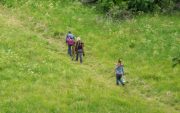
The only summers I remember

The only summers I remember
Were so long ago the moss grew
And contracted, gray and brittle of
Such age and unworthiness

Grassy refuge fell and tumbled house
Disappeared from reality
Mists grew before eyes unable
Or unworthy to let go

The only summers worth summoning
Seem to pull yet further as fall
Without shame intervenes
And treeless leaves gather

And blow begone with no regard
For foot-dragging eye-squinting
Mumble-dim revision
Or re-visioning

The only summers’ slowly fading
Leaving traces only
Flickering transitory ghosts
But the worst of it is the sheer

Lack of spectacle the way lovers long gone
Become mere characters in your story

The way life used to be

Summer mornings, when I was very young
My father would announce an outing
And my mother packed a lunch
And gathered up my infant sister

My older brothers, eye-rolling
And infinitely wise, despairing of
The younger generation
Gathered necessities defined by long
(several weeks)
Tradition and off we trundled

Those days, people walked
And so did we
Past shoe shops and drugstores
(always a brief, longing pause)
Hill high houses and pooched porches
Scraggle lawn-bare bungalows
Vacant lots, still equipped
With bottle bases and cardboard home plates
And the occasional mildewed fielder’s mitt
Wantonly discarded in a fit of pique

Past milk jugs left in sun-swept doorways
Cars on concrete blocks, their wheels
Unseen and unimagined

Down past side streets and alleyways
And trellised garden glimpses
Down to the parkway past
The big-bricked library
Packed from floor to ceiling
With adventure, intrigue,
Piracy and noble experiment,
With love and loss,
With everything that was not us
On summer mornings

Across the broad car-fringed roadway we went
To a certain large elm
Strewn about with green immortal grass
And laid out our blankets
Ate our lunch
And dozed the day away
My brothers off on some creek-filled adventure

Was life unkind?
Probably, obliviously, inobviously,
And perfectly.

If you live long enough

If you live long enough, you will see them die.
Longer still, and they fall like spring snow.
There are those who say grief is all second-hand,
That we grieve for ourselves alone
When those too like us prove mortal.

I suppose, for the first fierce blow,
That’s true: we stumble forward, gut-shot,
All death and bewilderment;
But after that? After the long parade begins in earnest?

True, a kind of acceptance sinks in,
A not-quite numbness, a sedation,
A shaking of the head, “Why,
Just yesterday…”

But there are ghosts.
They follow us everywhere,
And in some unguarded moment, a grief descends
Pure and sweet, almost holy,
And wholly devoid of self.

In these moments
We cradle our memories like children,
And all we long for
Is one more touch.

So long

…and the sad gypsy sang for his bottle of wine, and I sang along for mine.
-Jose Feliciano

Those days, we were dangerously close to dying,
To the end of all the longing we mistook
For grand poesie.
Lost on the road to anywhere,
We stepped toward no paradise,
Discarded all loving touch
But for human companionship,
Asking too much of the world, unable to grasp
The small treasures.

If there’s something missed, something lost,
It’s only the wide-open sky we saw
Through vinegar eyes,
Our salted wounds as yet unburied.

Come back to me, my own true self,
Come back, and we’ll slip away
To some long, true corner
And watch the setting sun.

1 1/2 haibun

Last night, I awoke from a dream of my childhood, startled to find tears in my eyes. There were the four of us children together, including my long dead brother, second in age, just older than I, and thus relegated to the task of keeping me on the proper path of life, as determined by whatever demons and angels that informed his conscience. In the dream, he was chiding me for some transgression which I have now lost to memory, as happens with dreams. I only know that, when I awoke, I was filled with such a love and tenderness for him as I haven’t felt since he died, many years ago. I got up and looked out the window, at the snow-covered landscape revealed by the light of a streetlamp, and what came to me was the final sentence of James Joyce’s story, The Dead:

His soul swooned slowly as he heard the snow falling faintly through the universe and faintly falling, like the descent of their last end, upon all the living and the dead.

Which in turn put me in mind of the Michael P. Smith song, The Dutchman, especially this verse:

When Amsterdam is golden in the summer,
Margaret brings him breakfast,
She believes him.
He thinks the tulips bloom beneath the snow.

What came out of all this before I went back to bed was a trio of haiku, or, I suppose more accurately, two haiku and one senryu.

The Winter snow
Falls equally
On living and dead

No tulips bloom
Beneath the snow
Only dreams

Heaven and hell
Are but regions of the heart
With contested borders