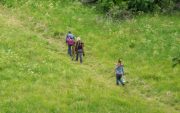
Fern Hill, by Dylan Thomas

If I had to choose the single biggest influence on my poetry, it would be Dylan Thomas. The wild, unexpected images, at once daring and inevitable, just turned my head as a young man. Here’s one of my favorites.

Now as I was young and easy under the apple boughs
About the lilting house and happy as the grass was green,
The night above the dingle starry,
Time let me hail and climb
Golden in the heydays of his eyes,
And honoured among wagons I was prince of the apple towns
And once below a time I lordly had the trees and leaves
Trail with daisies and barley
Down the rivers of the windfall light.

And as I was green and carefree, famous among the barns
About the happy yard and singing as the farm was home,
In the sun that is young once only,
Time let me play and be
Golden in the mercy of his means,
And green and golden I was huntsman and herdsman, the calves
Sang to my horn, the foxes on the hills barked clear and cold,
And the sabbath rang slowly
In the pebbles of the holy streams.

All the sun long it was running, it was lovely, the hay
Fields high as the house, the tunes from the chimneys, it was air
And playing, lovely and watery
And fire green as grass.
And nightly under the simple stars
As I rode to sleep the owls were bearing the farm away,
All the moon long I heard, blessed among stables, the nightjars
Flying with the ricks, and the horses
Flashing into the dark.

And then to awake, and the farm, like a wanderer white
With the dew, come back, the cock on his shoulder: it was all
Shining, it was Adam and maiden,
The sky gathered again
And the sun grew round that very day.
So it must have been after the birth of the simple light
In the first, spinning place, the spellbound horses walking warm
Out of the whinnying green stable
On to the fields of praise.

And honoured among foxes and pheasants by the gay house
Under the new made clouds and happy as the heart was long,
In the sun born over and over,
I ran my heedless ways,
My wishes raced through the house high hay
And nothing I cared, at my sky blue trades, that time allows
In all his tuneful turning so few and such morning songs
Before the children green and golden
Follow him out of grace,

Nothing I cared, in the lamb white days, that time would take me
Up to the swallow thronged loft by the shadow of my hand,
In the moon that is always rising,
Nor that riding to sleep
I should hear him fly with the high fields
And wake to the farm forever fled from the childless land.
Oh as I was young and easy in the mercy of his means,
Time held me green and dying
Though I sang in my chains like the sea.

I find the last two lines especially poignant.

Poetic Lineages: The Wild Swans at Coole, by William Butler Yeats

A very good poet might make you despair and give up writing for envy, but a great poet will inspire you to write more and greater poems. So, this by Yeats:

The trees are in their autumn beauty,
The woodland paths are dry,
Under the October twilight the water
Mirrors a still sky;
Upon the brimming water among the stones
Are nine and fifty swans.

The nineteenth Autumn has come upon me
Since I first made my count;
I saw, before I had well finished,
All suddenly mount
And scatter wheeling in great broken rings
Upon their clamorous wings.

I have looked upon those brilliant creatures,
And now my heart is sore.
All’s changed since I, hearing at twilight,
The first time on this shore,
The bell-beat of their wings above my head,
Trod with a lighter tread.

Unwearied still, lover by lover,
They paddle in the cold,
Companionable streams or climb the air;
Their hearts have not grown old;
Passion or conquest, wander where they will,
Attend upon them still.

But now they drift on the still water
Mysterious, beautiful;
Among what rushes will they build,
By what lake’s edge or pool
Delight men’s eyes, when I awake some day
To find they have flown away?

*Poetic lineages, in which I post great poems from the past, will now be a regular feature of this blog, roughly bi-monthly. Most of the poets I choose will be sufficiently dead to be in the public domain, but some will not. I hope I won’t be stepping on copyright considerations by featuring them!

An autumn haiku

Fall comes upon us
All gaudy and draped in red
Like yesterday’s blood

1914 III: The dead, by Rupert Brooke

Tomorrow is Veteran’s Day here in the US.

Blow out, you bugles, over the rich Dead!
There’s none of these so lonely and poor of old,
But, dying, has made us rarer gifts than gold.
These laid the world away; poured out the red
Sweet wine of youth; gave up the years to be
Of work and joy, and that unhoped serene,
That men call age; and those who would have been,
Their sons, they gave, their immortality.

Blow, bugles, blow! They brought us, for our dearth,
Holiness, lacked so long, and Love, and Pain.
Honour has come back, as a king, to earth,
And paid his subjects with a royal wage;
And Nobleness walks in our ways again;
And we have come into our heritage.

How we were then

In those dim grassy
harp-infused summers, we
longed for gray days
in redemption of living well,
the irony cloaked in
naïve dissolution.

We rejected willy-nilly
all that was pre-primed, packaged,
brightly colored.

For us, the rough edge, the ill-fit,
the soiled and discarded,
dust-blown cowboys
blues men smelling of urine
pawn shops, dives,

anything
dismissed and mistreated,
we imagined our own.

How we trotted out our patchy
lives, how we dwindled in our
constructed agony,
tethered all along
to a safe and sorry fate
we could not quite discard!

Is it a kind of hubris
to deny good fortune?

Or is it mere antithesis,
the dark side of a moon
unworthy of its borrowed shine?